Thursday, 11 October 2012

'FRACKING RACHEL CARSON' 50th Anniversary of 'Silent Spring' Sandra Steingraber

RACHEL CARSON
HER FOURTH BOOK IGNITED A GLOBAL AWARENESS MOVEMENT
ON HAWK MOUNTAIN
'FRACKING' = HYDRAULIC FRACTURING
FRACKING INJECTS DOZENS OF HIGHLY CARCINOGENIC CHEMICALS
 INTO GROUND WATER AQUIFERS
HALLIBURTON IS DIRECTED BY DICK CHENEY, 9/11 & 'GEO-TERRORISM' MASTER-MIND
RACHEL THE NATURE PHOTOGRAPHER
IN APPALACHIAN MOUNTAINS


'The Fracking of Rachel Carson' Sandra Steingraber


Dr. Theo Colborn, co-author Our Stolen Future, on health effects of water contamination by fracking chemicals


'Through a Narrow Window', Chapter 13 of Silent Spring (excerpts) 


Silent Spring full text pdf free down-load


1. Rachel Carson, the ecologist who kicked the hornet’s nest, wrote a book that needed no subtitle. Published fifty years ago this September, Silent Spring rocketed to the top of the bestseller list, prompted a meeting with the president’s science advisers, occasioned congressional hearings, and circled her neck with medals of honor. It also let loose swarms of invective from the pesticide industry. Throughout it all, Carson remained calm. Friends and foes alike praised her graceful comportment and gentle voice. Also, her stylish suits and trim figure. Nevertheless, her various publicity photos (with microscope; in the woods; outside her summer cottage in Maine; at home in Maryland) look as if the same thought bubble hovers above them all:

2. In the later portraits, Carson was dying of breast cancer. It was a diagnosis she hid out of fear that her enemies in industry would use her medical situation to attack her scientific objectivity and, most especially, her carefully constructed argument about the role that petrochemicals (especially pesticides) played in the story of human cancer. But behind her unflappable public composure, Carson’s private writings reveal how much physical anguish she endured. Bone metastases. Radiation burns. Angina. Knowing this, you can imagine her patience running out during the interminable photo shoots. The wretched wig hot and itchy under the lights. The stabbing pains (cervical vertebrae splintered with tumors) that would not, would not relent. 

3. In the iconic Hawk Mountain photo, Rachel Carson is truly beautiful. Her smile looks natural rather than forced. Posed on a rocky summit, she is wearing a badass leather jacket and wields a pair of leather-strapped binoculars. So armed, she scans the horizon. At her feet, the whole of Berks County, Pennsylvania, unfurls, forest and valley, field and mountain, like a verse from a Pete Seeger song.

4. Hawk Mountain, along the Appalachian flyway, is an officially designated refuge for raptors. As with so many sanctuaries, it started out as a hunting ground with bounties. By the mid-1930s, it had become the spot in Pennsylvania to witness the annual fall migration of hawks. Rachel Carson loved it here. She wrote about her experiences in a never-finished, never-published essay titled “Road of the Hawks.” According to biographer Linda Lear—who gathered the fragments into the collection Lost Woods: The Discovered Writing of Rachel Carson—the essay is notable not only for its careful analysis of bird behavior and knowledge of geology but also because Carson traced the origin of her airy lookout to Paleozoic marine organisms.

5.
And always in these Appalachian highlands there are reminders of those ancient seas that more than once lay over all this land . . . these whitened limestone rocks on which I am sitting . . . were formed under that Paleozoic ocean, of the myriad tiny skeletons of creatures that drifted in its waters. Now I lie back with half closed eyes and try to realize that I am at the bottom of another ocean—an ocean of air on which the hawks are sailing.
6. She sat on a mountaintop and thought about oceans. 

7. The marine inhabitants of the ancient seas that once overlay Appalachia transformed, when they died, into gaseous bubbles of methane. Pressed under the accumulated weight of silt sifting down from nearby mountains, the seafloor solidified into what’s now called the Marcellus Shale, a layer of bedrock that’s located under thousands of feet of what we would call the earth, but the mining industry calls overburden: the material that lies between the surface and an area of economic interest. To extract methane bubbles from the area of economic interest, the natural gas industry is now blowing up the state of Pennsylvania.

8. High-volume, slickwater, horizontal hydrofracking would be considered a crime if the requirements of the Safe Drinking Water Act, which regulates underground chemical injections, pertained. 

9. But they don’t. In 2005, fracking was granted specific exemptions from the Safe Drinking Water Act. Fracking is also exempt from key provisions within the Clean Air Act and the Clean Water Act. Chemicals used in drilling and fracking operations can be claimed as trade secrets; public release of their identity is not mandated by federal right-to-know provisions. The Environmental Protection Agency has limited jurisdiction over fracking.

10. The Environmental Protection Agency credits Silent Spring for its existence.

11. You can think of fracking as a hostage exchange program. A drill bit opens a hole a mile deep, turns sideways, and then, like a robotic mole, tunnels horizontally through the shale bedrock for another mile or more. The hole is lined with steel pipe and cement. To initiate the fracturing process, explosives are sent down it. Then, fresh water (millions of gallons per well) is injected under high pressure to further break up the shale and shoot acids, biocides, friction reducers, and sand grains deep into the cracks. Trapped for 400 million years, the gas is now free to flow through the propped-open fractures up to the surface, where it is condensed, compressed, and sent to market via a network of pipelines. The water remains behind.

12. Within the rumply state of Pennsylvania is a place called Triple Divide, where three adjacent springs feed the watersheds of three mighty rivers: the Allegheny (which flows west to the Mississippi River); the Susquehanna (which flows east to Chesapeake Bay); and the Genesee (which flows north to Lake Ontario). This area of Pennsylvania—which is the sixth most populous state in the union, which sits upwind and upstream from the eleventh most populous state of New Jersey and the third most populous state of New York—lies in the heart of the ongoing fracking boom in the eastern U.S. According to the Pennsylvania Land Trust Association, drillers in the Marcellus Shale amassed 1,614 violations of state oil and gas laws between January 2008 and August 2010. In one incident, a well blowout near the Punxsutawney Hunting Club in Clearfield County sent 35,000 gallons of toxic effluent into a state forest over the course of sixteen hours. Campers were evacuated.

13. Rachel Carson was born on May 27, 1907, and grew up on the outskirts of Springdale, sixteen miles from Pittsburgh. Her lifelong devotion to the sea began as a small child when she discovered, on a rocky hillside near her family’s farm, a fossilized shell. A sea creature in Allegheny County, Pennsylvania.

14. Actually, only some of the frack water stays behind in the shale. The rest, now mixed with brine and radioactivity, shoots up to the surface with the gas. Finding a safe place to dispose of this toxic flowback is an unsolved problem. Sometimes, the waste from drilling is just dumped on the ground. That’s illegal, but it happens. Sometimes the waste is dumped down other holes. In 2010, 200,000 gallons were poured down an abandoned well on the edge of Allegheny National Forest. Much of the flowback fluid is trucked to northeast Ohio, where it is forced, under pressure, into permeable rock via deep injection wells. This practice, the Ohio Department of Natural Resources has concluded, is the likely cause of the unusual swarm of earthquakes that shook northeast Ohio in 2011.

15. Most of the state’s fracking operations are set to take place in Pennsylvania’s forests. To be precise, 64 percent of Pennsylvania gas wells are to be drilled in forested land, which includes state forests and natural areas. For each well pad sited in a forested area, an average of nine acres of habitat are destroyed, says The Nature Conservancy’s Pennsylvania chapter (each well pad can accommodate up to six wells). The total direct and indirect impact is thirty acres of forest for each well pad. This does not include acreage lost to pipelines. On average, each well pad requires 1.65 miles of gathering pipelines, which carry the gas to a network of larger transporting pipelines.

16. Somewhere between 60,000 and 100,000 wells are planned for Pennsylvania, to be built over the next few decades. The Nature Conservancy forecasts the destruction of 360,000 to 900,000 acres of interior forest habitat due to pipeline right-of-ways alone. 

17. They are fracking Allegheny County.

18. They are sizing up Berks County, too.

19. Berks Gas Truth is a grassroots antifracking organization that focuses on human rights. The group is fond of quoting Article 1, Section 27, of the Pennsylvania Constitution:
The people have a right to clean air, pure water, and to the preservation of the natural, scenic, historic, and esthetic values of the environment. Pennsylvania’s public natural resources are the common property of all the people, including generations yet to come. As trustee of these resources, the Commonweath shall conserve and maintain them for the benefit of all the people.
20. Carson had a lot to say about human rights. In Silent Spring:
If the Bill of Rights contains no guarantee that a citizen shall be secure against lethal poisons distributed either by private individuals or by public officials, it is surely only because our forefathers, despite their considerable wisdom and foresight, could conceive of no such problem.
In congressional testimony (June 1963):
[I assert] the right of the citizen to be secure in his own home against the intrusions of poisons applied by other persons. I speak not as a lawyer but as a biologist and as a human being, but I strongly feel that this is or should be one of the basic human rights.
From her final speech (San Francisco, October 1963): 
Underlying all of these problems of introducing contamination into our world is the question of moral responsibility. . . . [T]he threat is infinitely greater to the generations unborn; to those who have no voice in the decisions of today, and that fact alone makes our responsibility a heavy one.
21. Human rights were not always Carson’s focus. Indeed, her bestselling trilogy of books about the sea—Under the Sea Wind (1941), The Sea Around UsThe Edge of the Sea(1955)—gives an adventurous account of a world in which the human race scarcely appears. If we the readers could visualize the oceanic world below the waves—full of communities of interacting creatures that possessed agency and distinct personalities—we might, the author believed, experience wonder and humility. And wonder and humility, said Carson, “do not exist side by side with a lust for destruction.” By contrast, the book she longed to begin at the time of her death was going to be all about environmental destruction—and the human rights violations that occur as a result. To halt the growing contamination of the oceans, to counteract a culture of conquest and annihilation, required more than humility, Carson had come to believe. It called for confrontation and witness. Nevertheless, she was also, at the time of her death, working on a book-length expansion of an essay titled “Help Your Child to Wonder.” (1951)

22. The Springdale where Rachel Carson lived as a child was no preindustrial, Romantic garden. The stench of the local glue factory was horrible. By the time she left for graduate school at Johns Hopkins in 1929, two coal-burning power plants flanked the town and were plainly contaminating both the river and the air. “The memory of the defilement industrial pollution brought,” said Linda Lear, would remain with Carson for the rest of her life.

23. To honor Carson (and promote tourism), the Springdale Team of Active Residents coined a new slogan for the town: Where Green Was Born.
 
24. According to a 2010 investigation by the Pittsburgh Post-Gazette, residents of Springdale have higher than average rates of death from lung cancers and heart ailments linked to air pollution. Quoted in the article, the then-director of the Rachel Carson Homestead Association, Patricia DeMarco, said, “We’re in a black hole here, where companies put out pollution and take in profits while the costs to our air and water quality are borne by the public.” DeMarco characterized Springdale residents as being quick to accept pollution as normal. 

25. Silent Spring predated the nation’s cancer registry program, which came into being under Richard Nixon and mandated that all states track cancer incidence within their populations. Without registry data—and the information about the changing rates of cancer they provide—Carson was left with only case studies and mortality data to work with. She also lacked sophisticated geographic information systems (GIS) and computer mapping programs that can generate visually compelling pictures of potential cancer clusters and other spatial patterns for statistical analysis. In 1960, there were no right-to-know laws, pesticide registries, or Toxics Release Inventories. There were no statewide women’s breast cancer groups that monitor public and academic research. Carson painstakingly pieced together the evidence available to her—reports of farmers with bone marrow degeneration, sheep with nasal tumors, spray-gun-toting housewives with leukemia—and concluded that cancer was striking the general population with increasing frequency. She believed that she was seeing the early signs of an epidemic in slow motion. She was especially concerned with the apparent rise in cancers among children. And she was right.

26. April 2012 was a silent spring in Pennsylvania. Funds for a statewide heath registry—which would track illnesses in residents who live near drilling and fracking operations—were quietly removed from the state budget. At the same time, a new state law, Act 13, went into effect, which allows a physician in Pennsylvania access to proprietary chemical information for purposes of treating a possibly exposed patient—but only if he or she signs a confidentiality agreement. Confounded, Pennsylvania doctors began asking questions. Does that mean no contacting the public health department? What about talking to reporters or writing up case studies for the New England Journal of Medicine? Can a physician who signs the nondisclosure agreement (in order to treat a patient) and then issues an alert to the community at large (in order to fulfill an ethical obligation to prevent harm) be sued for breach of contract? The president of the Pennsylvania Medical Society registered her objections, to which Pennsylvania Speaker of the House Sam Smith furiously counter-objected. Denying that Act 13 constitutes a medical gag order, Smith’s spokesman accused objecting doctors of yelling fire in a crowded theater.

27. Still waiting for the Pennsylvania Medical Society to point out that, verily, the theater is burning. 

28. Rachel Carson was diagnosed with breast cancer in April 1960, although she would not find out until the following December. Her physician did not tell her the results of the biopsy. Her cancer rapidly metastasized. With her next surgeon, she insisted on full disclosure. She knew the news would not be good. Nevertheless, she wrote to him in February 1963, “I still believe in the old Churchillian determination to fight each battle as it comes. (‘We will fight on the beaches—’ etc.)”

29. In 2011, Chesapeake Energy, a top producer of natural gas, was a corporate sponsor of the Pennsylvania Breast Cancer Coalition. In response to questions about possible conflicts of interest, the coalition’s executive director Heather Hibshman said, “I’m not a scientist. I’m not a researcher. I run a nonprofit. I’m going to leave it at that.” Hibshman also said that she was unaware of any correlations between fracking and breast cancer.

30. Fracking for the cure. 

31. In Silent Spring, Rachel Carson pointed out that pesticides were rapidly rolled out after World War II not because of some unmet pest-control need (like, say, farmers suddenly overrun with bugs and weeds). Rather, abundant leftover stockpiles from wartime use were in need of a domestic market. And so, with the help of Madison Avenue, one was created. DDT, a military weapon, was thus repurposed for domestic use without any premarket testing for safety. An abundance of former military planes that could be cheaply converted into spray planes—and an abundance of former military pilots who loved to fly them—helped seal the deal.

32. In March 2012, it was announced that the town of Monaca, in Beaver County, Pennsylvania (twenty-eight miles northwest of Pittsburgh), would be the site for a massive new ethylene cracker facility—the first in Appalachia—that will create chemical feedstocks for the plastics industry out of the other hydrocarbons that come up with the gas when Marcellus Shale is fracked. Most notably, ethane. This plant is being rolled out not because of some unmet need for more plastic. Rather, it is being built to solve a disposal problem for the energy industry and—of course—to create jobs. Petrochemical crackers are notorious air polluters, and the air of Beaver County, Pennsylvania, already exceeds legal limits for ground-level ozone (smog) and fine particles, which is the very sort of pollution that crackers create. Michael Krancer, Pennsylvania’s Department of Environmental Protection secretary, is not worried. “The plant will be state-of-the-art and built by a world-wide, world-class, environmentally responsible company.” 

33. That company would be Shell Oil.

34. The biggest repository for plastic waste is the ocean. It was Captain Charles Moore who discovered, in 1999, that the mass of plastic fragments in the central Pacific now outweighs the zooplankton by a factor of six. Sunlight and wave action break the fragments into smaller and smaller bits, but no one knows how small the bits can become or how long they last. It’s possible that some common plastics never degrade in the ocean. It’s possible that these plastic particles absorb organic toxicants. It’s certain that plastic particles are consumed by marine organisms, including the fish that are then consumed by us. According to the National Oceanic and Atmospheric Administration, the best way for individuals to address the problem of plastic waste in our oceans is to use less and recycle more. Blocking a convoy of fracking trucks is not on its list of recommended actions.

35. Rachel Carson’s final speech, “The Pollution of Our Environment,” was delivered six months before her death. By then, her pelvis was pocked with tumors and she walked with great difficulty. To her audience, a convocation of 1,500 physicians and medical professionals, she asked why. Why, in the face of overwhelming evidence of human harm, do we continue to pollute? Why do we pretend that alternatives to defilement and risk do not exist, even when other courses of action are available to us? Or, to use Carson’s framing, why do we behave “not like people guided by scientific knowledge, but more like the proverbial bad housekeeper who sweeps dirt under the rug in the hope of getting it out of sight”?

36. Says Businessweek, “The preferred way to dispose of the brine and fracking fluid . . . is to pump it out of sight, out of mind into deep, cavernous wells.” At last count, Ohio, with its permeable bedrock, has 176 such wells into which 511 million gallons of flowback waste have been injected. 

37. To her audience of doctors, an ailing Rachel Carson offered three explanations for our collective reluctance to give up on poisonous technologies. First, she said, we wait too long to evaluate the risks. Once a new technology is deployed and a vast economic and political commitment has been made, dislodging it becomes impossible.

38. Second, we fail to acknowledge that nature invariably has its own (unpredictable) way with harmful pollutants. Because ecosystems are dynamic, chemicals released into the environment do not stay where they are put, nor do they remain in their original form. Instead, they are transported, metabolized, concentrated, oxidized, methylated, and otherwise reassembled. They enter cycles and pathways. They are sent up food chains and passed down generations. Look, said Carson (who delivered her remarks while seated), the earth is alive. And living things interact with their environments. There are no compartments. 

39. Third, we act as though the evidence for harm in other animals does not apply to us even though we share biological ancestry and are thus clearly susceptible to damage from the same forces. This, in spite of the fact that “it would be hard to find any person of education who would deny the facts of evolution.” 

40. Oh, Rachel.

41. No comprehensive study on the human or animal health impacts of fracking has ever been conducted. However, using a case study approach, veterinarian Michelle Bamberger and Cornell biochemist Robert Oswald have been studying the impact of gas drilling on livestock, horses, pets, wildlife, and people who live in the gaslands of Pennsylvania. Nondisclosure agreements, trade secrets, litigation, and a general atmosphere of intimidation make their investigation difficult. So far, as described in a paper published in the environmental policy journal New Solutions, the team has documented widespread evidence of health and reproductive problems. In cattle exposed to fracking fluid: stillborn calves, cleft palates, milk contamination, death.

42. In cats and dogs: seizures, stillbirths, fur loss, vomiting. 

43. In humans: headaches, rashes, nosebleeds, vomiting.

44. In a private letter, Rachel Carson suggested another explanation for the prevalence of pollution. Scientists are cowards. Especially scientists who work in government agencies. The ones who are privy to the disconnect between the state of the scientific evidence and the policies that ignore that evidence. The ones who stay silent when they should be blowing whistles. 

45. Rachel Carson died in Silver Spring, Maryland, on April 14, 1964. Cause of death: breast cancer and heart disease. She was fifty-six.

46. In May 2012, Stephen Cleghorn, a farmer, scattered the ashes of his wife, Lucinda—who died of lung cancer—on their farm in Reynoldsville, Pennsylvania, which is in Jefferson County. The ceremony was unusual. It included a press conference, during which Cleghorn announced that, with this deposition of ash, he was hereby consecrating his land and declaring it off-limits to fracking in perpetuity. From here on out, the widower averred, “surface rights” (a concept whereby ownership of the surface land is separated from the mineral rights below) would refer to the rights of all beings whose lives are sustained at the surface and depend upon the clear, clean water that runs upon and below it:
May she who was tender and close and loving of me—now made dust and distant from me by cancerous death—come now in these ashes to declare this farm forever inviolate of shale gas drilling or any other attack upon it as a living system. Here now she declares a new right of love on the surface and below this farm that no gas drill will ever penetrate.
The goats bore witness.

47. We will fight on the beaches—etc.

48. In February 2012, Berks Gas Truth brought financial analyst Deborah Rogers to the Episcopal Church in Kutztown, Pennsylvania. Rogers lives in Fort Worth, Texas, and serves on the Advisory Council for the Federal Reserve Bank of Dallas. To her audience in Kutztown, Rogers argued that the economic fundamentals of shale gas were shaky. Gas reserves were smaller than projected, life spans of producing wells shorter. The leasing frenzy and subsequent speculation had produced financial bubbles. She pointed out that solar panels on a tract of land the same size as a well pad would generate electricity for twice as long as a shale gas well would bring methane up from bedrock. Rogers also noted that 94 percent of the gas wells in the Barnett Shale play in Texas emit benzene. Three months after Rogers’s lecture, researchers from the Colorado School of Public Health found elevated benzene levels in the ambient outdoor air of communities located near drilling and fracking operations in rural western Colorado. For residents living close to wells, benzene levels were high enough, according to the authors, to create acute and chronic health effects.

49. Memo to the Pennsylvania Breast Cancer Coalition: it’s been known for some time that benzene exposure causes leukemia and birth defects. As for a link between benzene and breast cancer, that possibility was affirmed by the Institute of Medicine in December 2011.

50.
If, having endured much, we have at last asserted our “right to know,” and if, knowing, we have concluded that we are being asked to take senseless and frightening risks, then we should no longer accept the counsel of those who tell us that we must fill our world with poisonous chemicals; we should look about and see what other course is open to us.
               —Rachel Carson, Silent Spring

Sandra Steingraber narrates a slide show about the fracking of Rachel Carson’s homeground at http://www.orionmagazine.org/fracking. This article was made possible by generous support from the Park Foundation.

Monday, 8 October 2012

'REMEMBERING ROSALIE BERTELL' Talk by Dr. Claudia von Werlhof/Australia Poised to Sell Uranium to India

 DR. ROSALIE BERTELL
 DR. CLAUDIA VON WERLHOF
 TESLA TECHNOLOGIES FOR TECHNETRONIC WARFARE
ROGUE STATE OF THE WORLD
 IRAN IS NOT AFGHANISTAN, IRAQ, LIBYA OR SYRIA
"IF WE DID PRECIOUS THINGS FROM THE LAND WE WILL INVITE DISASTER"  
HOPI PROPHECY
"NUCLEAR INDIA"
Australia is poised to sell uranium to India


NOTE FROM JEFF:  Many thanks to Claudia von Werlhof for carrying on the urgent work of Rosalie Bertell, both of whom are 'Rachels Carson of today' in very big ways. This work concerns not only awareness of all-things-nuclear which threaten the very fabric of life on Mothership Earth, but also the new generation of what Zbigniew Brzezinski calls 'technetronic' weapons systems based on micro-waves and Tesla technologies.  These systems are REAL and FULLY DEPLOYED.  They are behind many 'anomalous' earth-quakes, 'extreme weather', 'global warming', the melting of the ice caps as well as global cognition disruption in humans over entire hemispheres of the Earth.

'Earth changes' from biblical prophecies are upon us...but they are being created by premeditated human activity using our most advanced forms of technology.

We may have only a few micro-seconds of cosmic time left during which to successfully re-navigate our course towards oblivion:  every thought we think, every intention, every decision, every action or inaction...matters here on the brink of the unknown.

For more information see Dr. von Werlhof's site


Also my postings:

http://geo-terrorism.blogspot.com.au/2012/07/mother-earth-as-target-weapon-update-on.html 

http://geo-terrorism.blogspot.com.au/2012/05/global-radio-logical-catastrophe-and.html 

http://geo-terrorism.blogspot.com.au/2012/01/our-militaryasset-or-albatross-philip.html 

http://geo-terrorism.blogspot.com.au/2011/12/background-of-haarp-project-dr-rosalie.html 

http://geo-terrorism.blogspot.com.au/2011/06/claudia-von-werlhofdr-rosalie-bertell.html 

http://geo-terrorism.blogspot.com.au/2011/05/earthquakes-natural-or-man-made.html 

http://geo-terrorism.blogspot.com.au/2011/05/geophysicist-gordon-j.html 

Memorial: Remembering Rosalie Bertell
Toronto, 29th September 2012
7 pm, Church, 300 Bloor Str. W

Speech
Claudia von Werlhof, Austria

Good evening! 

This speech is about the prolongation of Rosalie´s efforts overseas!

Rosalie Bertell has changed my life:

It happened in 2010, 2 ½ years ago. I had heard about a debate that the terrible earthquake in Haiti in January of the same year may eventually have been produced artificially. It was like a heavy shock for me. And as I had lived nearby in Central America and Venezuela for many years, having been to Haiti as well, I took the opportunity of an interview for an Austrian newspaper to make this debate known publicly. I hoped to reach the people in Haiti and to mobilize researchers to investigate into the case.
What happened in reality was the opposite: I doubt that the people in Haiti ever have heard about those rumors until today. And for several weeks I was fiercely attacked by the media, my Institute at the University and Internet blogs for being a conspiracy theorist, mentally ill, and demands to be thrown out of my position at the University of Innsbruck grew. I was even attacked in my private sphere where someone had tried to find materials– materials about Haiti. Why that, if nothing unnatural had happened there?

I emerged from this second shock when I got the support of the President of my University and a large international campaign of friends all over the world, who supported me publicly. At that time I had learned that I had to do the research myself – and so I found Rosalie!

She wrote me that indeed there has been a development of military technologies in the decades after world War II that are able to produce earthquakes and even more seemingly natural catastrophes, like hurricanes, floods, droughts, volcanic eruptions, changes in the sea-currents and in whole weather-systems, including the melt down of the Arctic! – They are using the knowledge of Nicola Tesla, famous, but officially neglected Serbo-Croatian inventor in the fields of electricity and electromagnetism during the 19th and 20th centuries.

Rosalie even told me that the Haitian case could very well have been an example for an artificially induced earthquake, because the heating of the ionosphere which is needed to produce the earthquake by sending strongly pulsed electromagnetic waves through our heaven and back to earth, leaves plasma-lights like auroras in the sky – and this happened near Haiti at the time shortly before the earthquake. But, she added, nobody can prove it, neither whether the light was directly related to the accident, nor who had caused it, as there are so many nations in East and West already able to use these technologies!

And she sent me her book Planet Earth. The Latest Weapon of War, published in 2000, which has not been very well known internationally, because the publisher went bankrupt the same year. Maybe even some of you here do not know it yet! Indeed, I had heard about Rosalie and her book many years earlier and remembered it always in connection to international ecofeminism, but I had never seen it or her. 

Now I held it in my hands. And I have to tell you that I needed weeks to read it, because it was so shocking, again, and I felt earthquakes happening in my body itself while reading it.

This way Rosalie threw me into a new world: the one of our blue Planet and Mother Earth as the large and friendly, beautiful and unique cosmic living being that is our only home in the Universe, and that – unbelievably – is actually undergoing torture and murder, abuse and rape – the largest ongoing Witch-Hunt and Matricide in history! And the perpetrators are attacking and using exactly this Blue of our Planet, the atmospheric layers around it that are protecting all life on it. Without this Blue, our atmosphere, which Wilhelm Reich called life-energy, “Orgon”, life would never have appeared on Earth! This Blue marks the difference to all other planets around and in the Universe, but they, the military and their scientists, are attacking it, using it for their experiments and doing away with it, even before they have found out how it really works and how it is related to the whole of the earth´s body …Rosalie called it the possible Omnicide we are approaching if these activities cannot be stopped…

Who could have thought of such things happening before our eyes, but we being blind; happening since decades, but none of us knowing it; happening as a so called change of the eco-system or even a sudden development of our Planet to the allegedly higher, the more spiritual, the more divine! - But nobody recognizing it as the eventual result of a mega-crime of those really in power on this planet! The sciences have taught us for centuries not to see and feel and think anything, so that they can do whatever they want without having to fear an uprising of us, the people, the children and enthusiastic friends of our Mother Earth – that we, however,  aren´t any more! We have abandoned our cosmic mother, instead!
Rosalie had the strength and the courage to look at all this as closely as possible, and she was bold enough to analyze it as a method that turns our Mother Earth into a weapon of war and of mass destruction of us, life and herself as a planet. What a perversion! Rosalie went through all this with the clarity and sharpness of her mind and with the flame of love for life, for us and for our Mother Earth burning in her heart!

Rosalie has infected me! She has reflected on me my own intent to clarify our thinking, now even in fields so alien like the military sciences, and to rely on our love, this enormous capacity that gives us the strength to do much more than we are supposed to, and that gives us the vision we need to do it. Loving means to be able to do things that have nothing in common with egoism – as love is the big power that keeps everything on Earth related, united, alive and bonded. Love is the real and only anti-power against those who want to transform our world into a mega-machine under their control, and who do not hesitate to destroy it on their way! I have called this project „military – alchemy“, because it is obviously part of the intent to transform everything on earth into its opposite, a utopia which we call „patriarchy“. Rosalie was enthusiastic about this concept of military alchemy that relates to our paradigm of the "Critical Theory of Patriarchy“, as we call it. She even wanted to take „Military Alchemy“ as the title of her book´s new edition. Maybe we should really take it!
The three shocks I went through were a „Calling“. Something called upon me, it took me and shook me, it made me suffer, it made me ill, desperate and so terribly sad! I went through hell, again and again... This something told me: You are the one. You have to do it. You have to start a movement to protect the earth! And I got it: I became healthy, I became furious, I became strong: I said: YES! I am here, I am doing it, whatever it means for my further life.
At a spiritual-political women´s Congress in 2010 in Germany with about 600 participants from around the world I proposed the foundation of the „Planetary Movement for Mother Earth“. And most of the women were enthusiastic about it. So we founded it. And we started to inform the public and our members with our website (www.pbme-online.org) and Information Letters, always in three languages, 6 until today, and we did the most important thing: We gathered the money, found a very good translator and translated Rosalie´s Planet Earth into German, including her latest findings from the year 2000 to 2011, and including contributions from eco-feminist Vandana Shiva, India, from ethicist Clive Hamilton, Australia, from a German lawyer, specialist in ecology, and a German activist against Chemtrails. We even managed to publish this book, title in German „Kriegswaffe Planet Erde“, 500 pages, all included, 5000 copies 1st edition, at a reasonable prize, but with a horrible publisher. All the other publishers said: No. This is beyond our program, this is feminist, this is conspiracy theory. It was a battle we had to fight into every direction. But we made it. Nobody could finally prevent the book from appearing in Germany. And Rosalie had wanted it so much, as so many German scientists, like Wernher von Braun who had later been adopted by NASA, have contributed to develop the new weapons, first nuclear ones, then these energy weapons which use the earth´s magnetic fields and electromagnetic waves in order to be able to destroy the earth and us wherever they want it…

The military, says Rosalie, is at least 50 years ahead, and it never uses the weapons of the last war in a new one. And this new, secret war has already begun, without having been declared and recognized. People all over the world are living with it and dying through it already….

It can be seen in a climate change that has very little to do with greenhouse gas CO2; in the new allegedly “civil” geo-engineering, behind which stands the military and corporate capital; in weather wars, “Chemtrails”, plasma weapons; in the enormous growth in number and size of seemingly natural catastrophes, and in the Arctic meltdown which is occurring since the 70ies using Extreme Low Frequency, ELF-EM waves; it is to be seen in Ozone holes as produced by more than 2.000 nuclear tests that were launched against this Planet, by rockets and supersonic flights which left “holes” in the sky, and by “ionospheric heating” – all of them producing holes that let cosmic rays which are detrimental for life come down to earth; it is to be seen in very bad harvests and the dying of plants, as in the desertification of always more regions; it is to be seen in the weakening of the Van Allen belts, the magnetic fields around the earth…! Already in 1977 – 35 years ago – the UN in her ENMOD Convention tried to forbid the technologies which could be responsible for these damages, and it repeated its warning relating to geo-engineering in Nagoya, Japan in 2010. It seems that nobody is taking them seriously!

Rosalie had hoped that an International Court for Crimes against the Environment could be founded. But who really cares? She had hoped that the military, patriarchy and capitalism could even be abolished! But today it does not look like that, on the contrary. Rosalie had hoped that a large civil movement would emerge in order to save Mother Earth, but it didn´t. She said: Men are not going to save the Planet. And where are the women? There are women like Sandra Perlingieri, Leuren Moret, Rauni Kilde, Vandana Shiva – the “Rachel Carsons” of today. But the women in general are absent like the social movements Rosalie wished to see. Most of the existing movements are split, they are sometimes corrupt, they are trying to get to power in order to participate in the system instead of leaving it, and therefore they are weak, spiritually weak. They did not get it yet! They still think they can live and survive without bothering about Mother Earth!
We are happy and proud that Rosalie experienced the German edition of her book before she passed. Her former book for which she got the Right Livelihood Award: „No Immediate Danger? The Future of a Radioactive Earth“ appeared in German as well (in 1987). The nuclear dangers were her main and lifelong topic! And only later in her life she – as one of the first scientists – discovered that post-nuclear weaponry has been developed at the same time. Especially in view of the Fukushima catastrophe in 2011 which is several hundreds or even thousand times larger than that of Chernobyl (!), both of Rosalie´s books have to be read and analyzed again. We will need it when the results of the Fukushima disaster, which has probably also not been simply a natural catastrophe, can no longer be swept under the carpet.

We know that Rosalie was working on a second edition of “Planet Earth” in English. Together with her book on nuclear dangers it is going to be the eye opener for many people in the whole world and for many years to come. We, therefore, are now calling the two publishers she was in contact with, one in the US and one here in Canada. We do not know who you are! Please contact us so that we can finish what Rosalie had started! There is not much more to do!
And finally we have begun with a Spanish translation for which we still need support and money. In the meantime we have found a Mexican publisher. We want that indigenous peoples of the “Pachamama”-movements in Latin America can read it. So, when the people in Mexico knew about the harm that is done to our Pachamama, they started to cry! Imagine the difference to the reaction of people in Germany who started to shout at us, instead. This is development!

I met Rosalie personally in Bonn, Germany, in September 2010, when the Right Livelihood Award had its 30th anniversary. I will never forget how she looked at me with eyes radiant like black diamonds! We had already become friends. This is because we are acting out of the same motive: The war against life must end, the ongoing destruction has to be stopped, the risk of damaging the whole Planet and our general living conditions must not be allowed – and worldwide so! 

We stand up for Mother Earth!

Rosalie: we miss you, Rosalie: we need you! We want to be your heirs! We promise: Your work will be continued. For this I feel responsible. So we are just now preparing a documentary about your life and work!

Thank you, Grey Nuns of the Sacred Heart, thank you, members of the International Institute of Concern for Public Health! Without you and your love and support Rosalie would not have been able to do all the incredible things she did!

Wednesday, 12 September 2012

THE ABIOTIC ORIGIN OF PETROLEUM: FUELING THE NIGHTMARE OF INDISCRIMINATE DRIVING


 PETROLEUM IS NOT A 'FOSSIL FUEL'...
BUT ORIGINATES FROM DEEP ON-GOING GEO-CHEMISTRY 
and/or from ANCIENT EXTRA-TERRESTRIAL SOURCES LIKE COMETS


"IF WE DIG PRECIOUS THINGS FROM THE LAND, WE WILL INVITE DISASTER"  Hopi Prophecy

NOTE FROM JEFF: 'Abiotic' means 'not having to do with living organisms.'  Conventional 'wisdom' and mainstream science tell us that hydro-carbon compounds like petroleum are the result of fossilized organic matter from prehistoric plants and animals having been subjected to aeons of high pressure and temperature.  Implicit in this belief is the finite amount of these substances present on our planet.

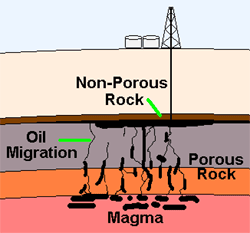
Massive solid evidence exists, however, for the 'abiotic' origin of petroleum, whereby these compounds arrived on Earth from extra-terrestrial sources, possibly comets (Velikovsky, Worlds in Collision), and were...and still are...being created by chemical and geological processes ongoing deep in the Earth's mantle.

The implication is that abiotic petroleum is unlimited in supply;  geophysical exploration techniques probing deeper and deeper into the Earth are finding oil at depths previously thought to be impossible.

The constant replenishment of deep petroleum deposits represents a worst-case scenario for the future of life as we know her:  rather than eventually 'running out', after who knows how many 'wars of aggression' have been under-taken to secure resource control for the dominant hegemones, we are faced with an unending supply of planetary blood feeding the vampire of military-industrial civilization.

With an unlimited 'food' supply, the cancer of technegenous 'civilization' will continue to spread over the surface of the Earth, destroying all life in its path and assimilating the remnants into a 'powaqatsi' nightmare of machines and synthetic 'life' forms.

The only possible hope we have is for large numbers of people voluntarily to stop consuming hydro-carbon fuels, primarily through the light-years of unnecessary driving that 'modern man' performs without question.

Most people are unaware that a large portion of the whole field of organic chemistry, which has provided us with the most toxic and mutagenic substances known to exist other than synthetic radio-nuclides, was born from the discovery of petroleum.

Petroleum and all its constituents and derivatives are highly toxic to biological life.


Fossils From Animals And Plants Are Not Necessary For Crude Oil And Natural Gas, Swedish Researchers Find

What would happen if it were proven that "fossil fuels" weren't the result of decayingplant and animal matter, were actually created within the Earth due to simple chemistry and you could not be scared into believing that we were "running out" of oil and natural gas?

Estimates of how much crude oil we have extracted from the planet vary wildly. As late as May of 2009 a report published in the International Journal of Oil, Gas and Coal Technology suggested that we may have used more than we think.

The idea that we are running out of oil is not a new one. Scientists have told us that oil is a limited resource which was formed millions of years ago by the decaying vegetation and biomass of extinct species of plants and animals. With an estimated 1- trillion barrels of oil already extracted from deep wells since commercial drilling began around 1870, many predict that we are nearing the mid-point of remaining oil on the planet.
But there have always been those who claim that oil is a natural substance that forms automatically in the Earth's mantle. They say that it is virtually everywhere, if you can drill deep enough to tap it.

Proponents of so-called "abiotic oil" claim that the proof is found in the fact that many capped wells, which were formerly dry of oil, are found to be plentiful again after many years, They claim that the replenished oil is manufactured by natural forces in the Earth's mantle.

Critics of the abiotic theory disagree. They claim that capped wells may appear to refill after a few years, but they are not regenerating. It is simply an effect of oil slowly migrating through pore spaces from areas of high pressure to the low-pressure area of the drill hole. If this oil is drawn out, it will take even longer for the hole to refill again. They hold that oil is a non-renewable resource generated and deposited under special biological and geological conditions.

Until now these believers in "abiotic oil" have been dismissed as professing "bad science" but -- alas -- a new study has proven them correct!

Reported in ScienceDaily, researchers at the Royal Institute of Technology (KTH) in Stockholm have managed to prove that fossils from animals and plants are not necessary for crude oil and natural gas to be generated. The findings are revolutionary since this means, on the one hand, that it will be much easier to find these sources of energy and, on the other hand, that they can be found all over the globe.

"Using our research we can even say where oil could be found in Sweden," says Vladimir Kutcherov, a professor at the Division of Energy Technology at KTH.

Together with two research colleagues, Vladimir Kutcherov has simulated the process involving pressure and heat that occurs naturally in the inner layers of the earth, the process that generates hydrocarbon, the primary component in oil and natural gas.

According to Vladimir Kutcherov, the findings are a clear indication that the oil supply is not about to end, which researchers and experts in the field have long feared.


Abiotic Oil
The abiotic oil formation theory suggests that crude oil is the result of naturally occurring and possibly ongoing geological processes. This theory was developed in the Soviet Union during the Cold War, as the Union needed to be self sufficient in terms of producing its own energy. The science behind the theory is sound and is based on experimental evidence in both the laboratory and in the field. This theory has helped to identify and therefore develop large numbers of gas and oil deposits. Examples of such fields are the South Khylchuyu field and the controversial Sakhalin II field.
In its simplest form, the theory is that carbon present in the magma beneath the crust reacts with hydrogen to form methane as well as a raft of other mainly alkane hydrocarbons. The reactions are more complicated than this, with several intermediate stages. Particular mineral rocks such as granite and other silicon based rocks act as catalysts, which speed up the reaction without actually becoming involved or consumed in the process.
Experiments have shown that under extreme conditions of heat and pressure it is possible to convert iron oxide, calcium carbonate and water into methane, with hydrocarbons containing up to 10 carbon atoms being produced by Russian scientists last century and confirmed in recent US experiments. The absence of large quantities of free gaseous oxygen in the magma prevents the hydrocarbons from burning and therefore forming the lower energy state molecule carbon dioxide. The conditions present in the Earth's mantle would easily be sufficient for these small hydrocarbon chains to polymerise into the longer chain molecules found in crude oil.

Vladimir Kutcherov adds that there is no way that fossil oil, with the help of gravity or other forces, could have seeped down to a depth of 10.5 kilometers in the state of Texas, for example, which is rich in oil deposits. As Vladimir Kutcherov sees it, this is further proof, alongside his own research findings, of the genesis of these energy sources -- that they can be created in other ways than via fossils. This has long been a matter of lively discussion among scientists.

"There is no doubt that our research proves that crude oil and natural gas are generated without the involvement of fossils. All types of bedrock can serve as reservoirs of oil," says Vladimir Kutcherov, who adds that this is true of land areas that have not yet been prospected for these energy sources.

But the discovery has more benefits. The degree of accuracy in finding oil is enhanced dramatically -- from 20 to 70 percent. Since drilling for oil and natural gas is a very expensive process, the cost picture will be radically altered for petroleum companies, and in the end probably for consumers as well.

"The savings will be in the many billions," says Vladimir Kutcherov.

To identify where it is worthwhile to drill for natural gas and oil, Vladimir Kutcherov has used his research to arrive at a new method. It involves dividing the globe into a finely meshed grid. The grid corresponds to fissures, so-called 'migration channels,' through underlying layers under the surface of the earth. Wherever these fissures meet, it is suitable to drill.

According to Vladimir Kutcherov, these research findings are extremely important, not least as 61 percent of theworld's energy consumption derives from crude oil and natural gas.

The next step in this research work will involve more experiments, but above all refining the method will make it easier to find places where it is suitable to drill for oil and natural gas.

Vladimir Kutcherov, Anton Kolesnikov, and Alexander Goncharov's research work was recently published in the scientific journal Nature Geoscience.


Methane-derived hydrocarbons produced under upper-mantle conditions
Anton Kolesnikov1,2, Vladimir G. Kutcherov2,3 & Alexander F. Goncharov1
Abstract
There is widespread evidence that petroleum originates from biological processes1, 2, 3. Whether hydrocarbons can also be produced from abiogenic precursor molecules under the high-pressure, high-temperature conditions characteristic of the upper mantle remains an open question. It has been proposed that hydrocarbons generated in the upper mantle could be transported through deep faults to shallower regions in the Earth's crust, and contribute to petroleum reserves4, 5. Here we use in situ Raman spectroscopy in laser-heated diamond anvil cells to monitor the chemical reactivity of methane and ethane under upper-mantle conditions. We show that when methane is exposed to pressures higher than 2 GPa, and to temperatures in the range of 1,000-1,500 K, it partially reacts to form saturated hydrocarbons containing 2-4 carbons (ethane, propane and butane) and molecular hydrogen and graphite. Conversely, exposure of ethane to similar conditions results in the production of methane, suggesting that the synthesis of saturated hydrocarbons is reversible. Our results support the suggestion that hydrocarbons heavier than methane can be produced by abiogenic processes in the upper mantle.
Other relevant studies:


1. Geophysical Laboratory, Carnegie Institution of Washington, Washington, District of Columbia 20015, USA
2. Lomonosov Moscow State Academy of Fine Chemical Technology, 117571 Moscow, Russia
3. Royal Institute of Technology, SE-100 44 Stockholm, Sweden

Wednesday, 5 September 2012

'The Sound of Extinction: Bernie Krause's Biophony'

The Sound of Extinction: Bernie Krause’s biophony

Musician, author and naturalist Bernie Krause has dedicated more than 40 years of his life recording the sounds of over 15,000 species around the world. His term for the sounds of all living organisms in the world’s habitat is “biophony.” Wondering how exactly he records nature’s biophony? According to The Independent:

"He found it through technology, though, communing with nature via headphones. This allows him to hear all the sounds together, instead of picking out individual sonic figures from the acoustic background. Perhaps artificial mediation makes it easier to get away from what is, after all, a perfectly natural way to organise incoming signals into patterns.
As he explored soundscapes around the world, he became a sonic ecologist. Recordings revealed that human disturbance could leave an environment acoustically degraded even though the place might look as though it had recovered – ironically, the evidence emerges when sounds are represented in visual form, as sonograms. Disturbance disorganises soundscapes, their patterns breaking down."
One of the advantages of having such a large archive of recordings is that Krause can notice deviations in the environment (and the species living in a habitat) from sound alone. Krause, who has been recording the sounds in nature since 1968, has acknowledged that 50 percent of his archive are no longer acoustically viable in a natural state.
He writes in a new book, The Great Animal Orchestra, about the sound of extinction:
"A great silence is spreading over the natural world even as the sound of man is becoming deafening. Little by little the vast orchestra of life, the chorus of the natural world, is in the process of being quietened. There has been a massive decrease in the density and diversity of key vocal creatures, both large and small. The sense of desolation extends beyond mere silence.
If you listen to a damaged soundscape … the community [of life] has been altered, and organisms have been destroyed, lost their habitat or been left to re-establish their places in the spectrum. As a result, some voices are gone entirely, while others aggressively compete to establish a new place in the increasingly disjointed chorus."
A classic example of the sound of extinction, as recorded and noticed by Krause, comes from the reefs in Fiji. The Guardian shares that in “the pristine coral reef waters of Fiji, [Krause] picks up a raucous mix of sighs, beats, glissandos, cries, groans, tones, grunts, beats and clicks,” but a mere half a mile away where the ”reef is badly damaged, [Krause] can only pick up the sound of waves and a few snapping shrimp.” This phenomenon of silence from extinction is not only found in the reefs–Krause has found similar deviations in in the Sierra Nevada mountains, amongst other place.
In fact, there are very few places in the world that are untainted by human interference and maintain natural sound. These rare, untouched regions include the Alaskan wilderness, the far Canadian north, Siberia, the pampas of Argentina and Uruguay, and the Brazilian Pantanal.